

Two plots of the exact same size in Jaipur can carry very different development potential — and very different value — because of a concept most buyers have heard of but few can explain clearly: FAR (Floor Area Ratio), sometimes called FSI (Floor Space Index). Here's what it actually means, and why the number matters more than the plot size alone.
The short version
FAR/FSI compares the total permitted floor area of a building to the area of the plot it sits on. It's one of the core concepts that explains why two plots of identical size can have different development potential — and therefore different economic value — even before you factor in location.
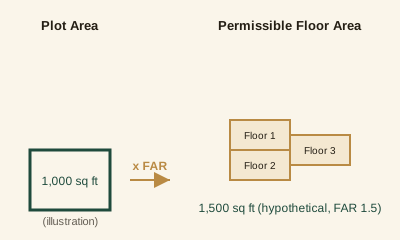
A simple example (illustration only)
If a hypothetical 1,000 sq ft plot had an applicable FAR of 1.5, the conceptual total permissible floor area would be 1,500 sq ft — which could be distributed across multiple floors, subject to height and other rules. This is purely an illustration of the mechanism, not a stated Jaipur rule; the actual applicable FAR for any real plot depends on its specific location, land use and category.
Why online FAR calculators can mislead
A generic calculator can show you the arithmetic, but actual development potential depends on more than a single ratio. Land-use classification, road width, setback requirements, height restrictions, plot category and other site-specific conditions all interact with FAR to determine what can actually be built. A number pulled from a general calculator, without matching it to the specific plot's official records, can be meaningfully wrong.
Why investors should care
The economic value of a plot is linked not just to its area, but to what can legally and practically be developed on it. A well-located plot with a restrictive FAR may support less built-up area than a similarly priced plot elsewhere with a more favourable ratio — which directly affects resale value, rental yield potential, and the economics of any construction plan.
How FAR interacts with other rules
| Related rule | How it interacts with FAR |
|---|---|
| Building height | Height limits can cap how the permissible floor area is actually stacked across floors |
| Setback rules | Setbacks reduce the usable footprint, affecting how FAR translates into built form |
| Land-use classification | Different land uses can carry different applicable FAR values |
Want the applicable FAR checked for a specific plot?
Share the plot details and we'll help you get this verified against official records before you factor it into your decision.
Key takeaway
For a common buyer, the practical lesson is to separate a headline ratio from the actual property decision. Verify the exact FAR applicable to the exact property, through the competent authority — not through an assumption or a generic calculator. A good location helps, but clean title, lawful land use, usable access and compliant development potential remain fundamental to the value of a plot.
Frequently Asked Questions
What's the difference between FAR and FSI?
They refer to the same underlying concept — the ratio of permissible built-up floor area to plot area — with FAR (Floor Area Ratio) and FSI (Floor Space Index) used somewhat interchangeably depending on the region and document.
Can I calculate FAR myself using an online tool?
You can get a rough sense of the arithmetic, but actual development potential depends on land use, road width, setbacks, height and other site-specific conditions. Always verify the applicable figure through official records for your specific plot.
Does a higher FAR always mean a more valuable plot?
Generally, more permissible floor area supports more value, but it's one factor among several — location, access, land use and civic infrastructure also matter significantly.
Sources & Further Reading
This article is general research and analysis, not legal, valuation or investment advice. Rules, approvals, project timelines and site-specific conditions can change. Readers should verify current records with the relevant authority before purchasing land, constructing, or relying on an infrastructure proposal.
Related Tools & Checklists
Free calculators and due-diligence checklists relevant to this topic — no sign-up required.